Recently I watched an interview on local Dutch TV station, Lokale Omroep Nuenen, that covers the work of my longtime friend Irma. Irma and I met and became friends at high school at the age of 12, almost 50 years ago. Over the years we have compared notes from time to time, and although we are living so far apart our lives still have a lot in common, even since my departure from the Netherlands in 1988.
After years of experience in funeral care, Irma has chosen to walk her own path as funeral director. This means that she can guide families on an even more personal level and together with them, design a farewell that really fits.
Discussion about death and dying is still a taboo topic in many places in the world. Realising the temporarity of our Earthly body before I even went to school, I remember having conversations with my mother about ‘what happens when you die’ and I recall looking hopefully at a beautiful black and grey chinese teaset with dragons in relief, displayed on the antique oak sideboard in our living room. When I asked if I could have it ‘when she died’ she reassured me that I could. That childhood memory still makes me smile.
Six years ago, I spent the last two weeks of my mother’s life as her full time carer, following a diagnosis of terminal cancer (to my knowledge the teaset was no longer in her possession and I didn’t ask Mum what happened to it). We talked a lot about life, and also about her final wishes.
My mum has always been a hard worker and extremely organised and in control until the moment she was no longer able to leave her bed and completely had to rely on me. She even managed to drive to town to close down her bank account and instruct her lawyer about her will, amongst other things. Although I could see how hard this was for her, I knew how important it was for her to remain as independent as possible, for as long as possible.
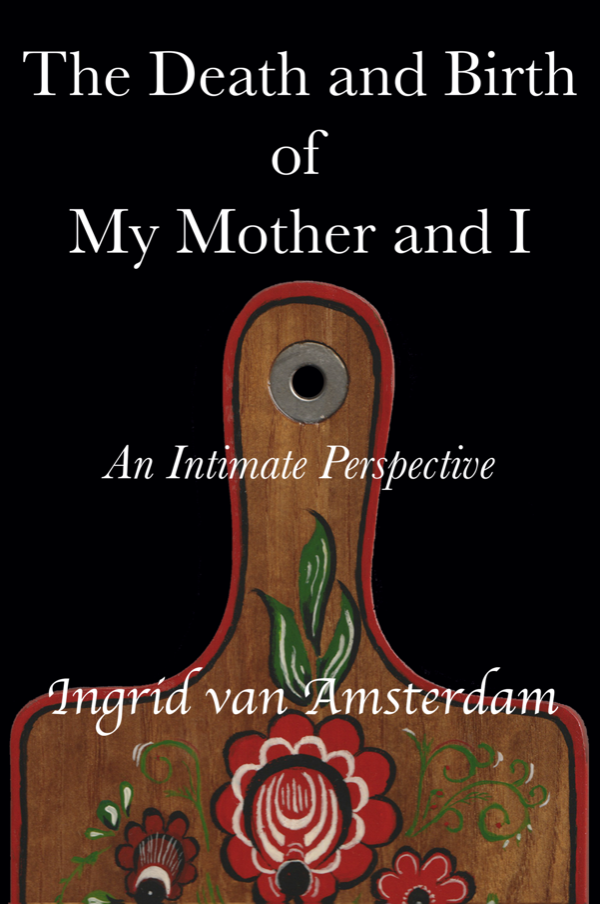
Witnessing her illness and death gave me some insight into this phenomenon, in that the process of dying, the passing on from the physical plane into another realm, can be a beautiful experience. I later wrote about this in The Death and Birth of My Mother and I.

Trying to visualise my own funeral, I discussed what I would imagine my final farewell should look like with my own children (a mountain of colourful flowers and incense; the flowers also a tribute to my father).
Irma’s interview talks about her work, in which she beautifully explains some of the cultural differences of funeral traditions within the (now more and more) cosmopolitan country. It is an open and down to earth conversation, not without emotion, that manages to take away the stigma of the subject.
I was so impressed that I decided to ask Irma if she’d be happy if I shared the video and I was absolutely delighted that she agreed. Watch Irma’s interview, followed by my (tweaked for the right nuance) translation of the Dutch transcript that accompanies the video.
Uitvaarten in Nederland, de mogelijkheden (Funerals in the Netherlands, the possibilities)
Interview with Irma van Laarhoven, Irma van Laarhoven Uitvaartzorg, by Lokale Omroep Nuenen (LON)
LON: “Dying is part of life.
Irma van Laarhoven works as an independent funeral director.
In our multicultural society, various funerals are possible. I will discuss this with Irma.”
Irma: “Funeral rituals are very different and also very personal. In the past, when someone had died, it came from within the church, the funeral. Then the pastor or minister visited the family where it was discussed how the funeral would be formed.
But more and more people are also choosing to say goodbye in a hall of a crematorium where you can really shape and give content to the service yourself.
There are also people who prefer a very small farewell: at home, in their own living room, or in the garden, and sometimes in the canteen of a sports club or another club building. If that place has meant a lot to someone, it can be very beautiful way to say goodbye there too.”
LON: “You may also be dealing with an Islamic funeral; a Jewish funeral; they have different wishes?”
Irma: “Yes. Yes. With the Muslims, when someone dies there – they want the farewell as soon as possible. Preferably the burial within 24 hours. They are wrapped in cloths and laid in the grave that way. Muslims are buried with their face towards Mecca, looking forward to eternal rest. So here at Oude Landen, a part of the cemetery is set up as an Islamic cemetery.”
LON: “And what about a Jewish funeral?”
Irma: “A Jewish funeral, that is also preferably as soon as possible after death. It is much more modest. There are no flowers there; no long speeches and such.
The Jews really have a great preference for a burial, so no cremation. Cremation – that of course reminds us very much of the Second World War. Yes, everyone knows what happened then and that is why most Jewish people prefer not to go to a crematorium.
At a Hindustani funeral, the coffin is often opened during the funeral so that everyone still has the opportunity to see the deceased. The Hindustani want to be cremated. The fire separates the spirit from the body that makes reincarnation is possible; the transition into a new life.
For another example the Chinese burn incense and money (fake money) by the grave before someone is buried; this is very important to them because then you give wealth to the deceased for their afterlife.”
LON: “Beautiful thought.”
Irma: “Yes precisely, yes.”
LON: “I also recently heard ‘wrapped in sheep’s wool’, at a natural burial site; and something in liquid?”
Irma: “Yes. First about natural burials: that is something that is also receiving more and more attention and interest. If someone is buried there; you do not have a gravestone. The grave becomes part of nature. It is often covered with a wooden plaque, which means that it is not anonymous and you can still find it more easily. Burial rights never have to be extended because it is actually a place forever.
Dissolving in water: resomation is what you call it, is not yet permitted in the Netherlands. The body dissolves in an alkaline liquid and then you are left with a kind of white powder which can be compared with the ashes after a cremation.”
LON: “Someone has died; you have conversations with the family.
Have you ever come across very unusual or extraordinary situations during such a process?”
Irma: “Sometimes you notice; when I am with a family; because of course I come in at a very difficult time, that some families share a lot with me.
With other people you also sometimes feel that there is a lot of mutual tension, old pain, because all of a sudden you must sit down with your brothers and sisters again to organise things.
I also sometimes feel relief: if someone has been ill for a long time, or has been in a lot of pain and then dies, then there is sometimes relief among the relatives because it is over and they can start to focus on a beautiful farewell.
These are very intense times, sometimes also very sad. It also affects me regularly.
People often ask: ‘How old was [someone] who died?’
‘Oh he was 92.’
‘Oh well, he has had a beautiful life.’
That is also true.
You also sometimes experience that people have been together for 65 years or so; have grown up together; have started a family together; have grown old together. And then as the surviving partner, you remain, alone. Well that can be so sad, then I can also get teary sometimes, yes. But I think that’s allowed.”


Heel mooi interview met Irma!
Ja heel mooi uitgelegd door Irma